


Vibration Plates & Lipedema: How to Find Your “Sweet Spot”
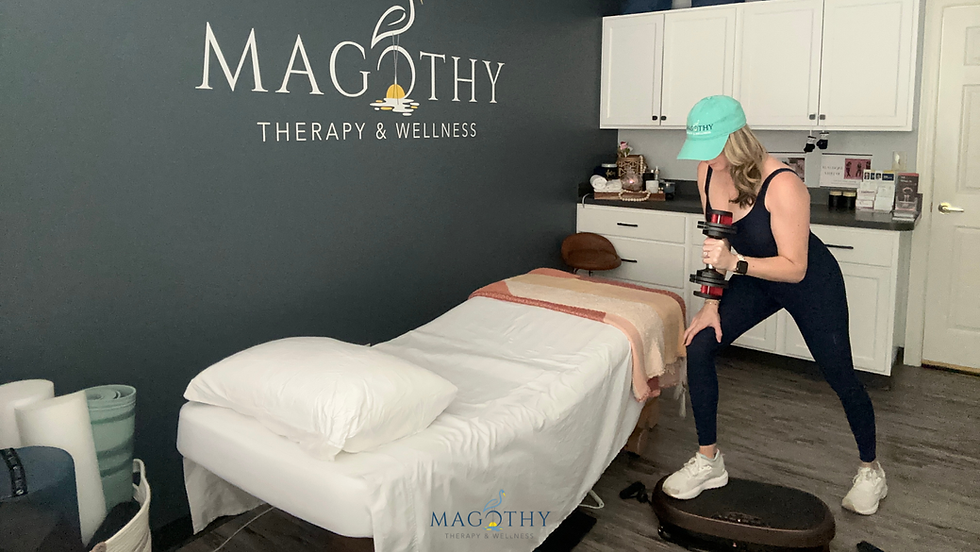
Vibration plates can be a fantastic addition to a lipedema movement routine, but more vibration isn’t necessarily better. If you’ve ever stepped onto a vibration plate and thought:
“Whoa…this is doing something!” You’re right. But if your next thought is: “Should I be shaking THIS much?” That’s where individualized guidance becomes important!
Vibration plates are not a one-size-fits-all tool. The type of vibration, frequency, amplitude, body position, foot placement, duration and intensity can all change how your body responds.
And when you’re managing lipedema, the goal isn’t to find the strongest setting.
The goal is to find YOUR sweet spot.
So…what should vibration feel like?
A vibration plate should generally feel like a stimulus, not a punishment. Depending on the setting and your position, you may notice:

Gentle shaking
Muscle activation
A buzzing or vibrating sensation
Increased awareness of your feet and legs
Mild warmth
A feeling that your muscles are “working”
A temporary increase in circulation or movement awareness
You may also experience some tingling. That isn’t necessarily a problem—but context matters.
If a sensation is mild, brief and resolves when you step off, it may simply reflect how your nerves, muscles and tissues are responding to the mechanical stimulus.
But if you experience significant numbness, pain, dizziness, loss of balance or persistent neurological symptoms, that’s a reason to stop and seek appropriate medical guidance.
What about itchiness?
This one deserves a little nuance. Some people report itching or unusual skin sensations when beginning vibration. There are several possible explanations, and itching by itself does NOT mean that you have MCAS or that you’ve “activated” mast cells.
However, if vibration consistently causes:
Itching
Flushing
Hives
Skin changes
Feeling suddenly hot
Swelling
Wheezing or other concerning symptoms
That’s a reason to stop and reassess the stimulus. For someone who knows they have mast-cell-related symptoms, this is especially worth discussing with their healthcare provider.
From a vibration-plate perspective, the first step is often simple: Reduce the stimulus.
Try: Lower intensity → shorter duration → different foot position → reassess.
Your body doesn’t get extra points for tolerating an uncomfortable response.
And what about feeling like you just ran a marathon?
That’s probably not the goal. You shouldn’t need to finish a vibration-plate session feeling completely depleted.
Remember: More intensity ≠ more benefit.
If your legs feel exhausted, you’re nauseated, dizzy, unusually fatigued or feel like you just completed a marathon after a few minutes on the plate, your current dose may simply be too much for you.
Think about vibration like exercise: Dose matters. We can manipulate:
Intensity
Frequency
Duration
Position
Foot placement
Number of exercises
Rest periods
The goal is to find the amount of stimulus your body can tolerate and recover from.
Let’s talk about tingling
Tingling can be a tricky one. A mild temporary buzzing sensation may simply be part of experiencing mechanical vibration. But persistent or worsening tingling, numbness, burning, weakness or pain deserves attention.
If you have peripheral neuropathy, altered sensation, vascular conditions or another neurological concern, vibration should be individualized with your healthcare team.
This is one reason I don’t love the advice: “Just turn it up until you really feel it.”
Your nervous system deserves more respect than that.
Not all vibration plates are the same
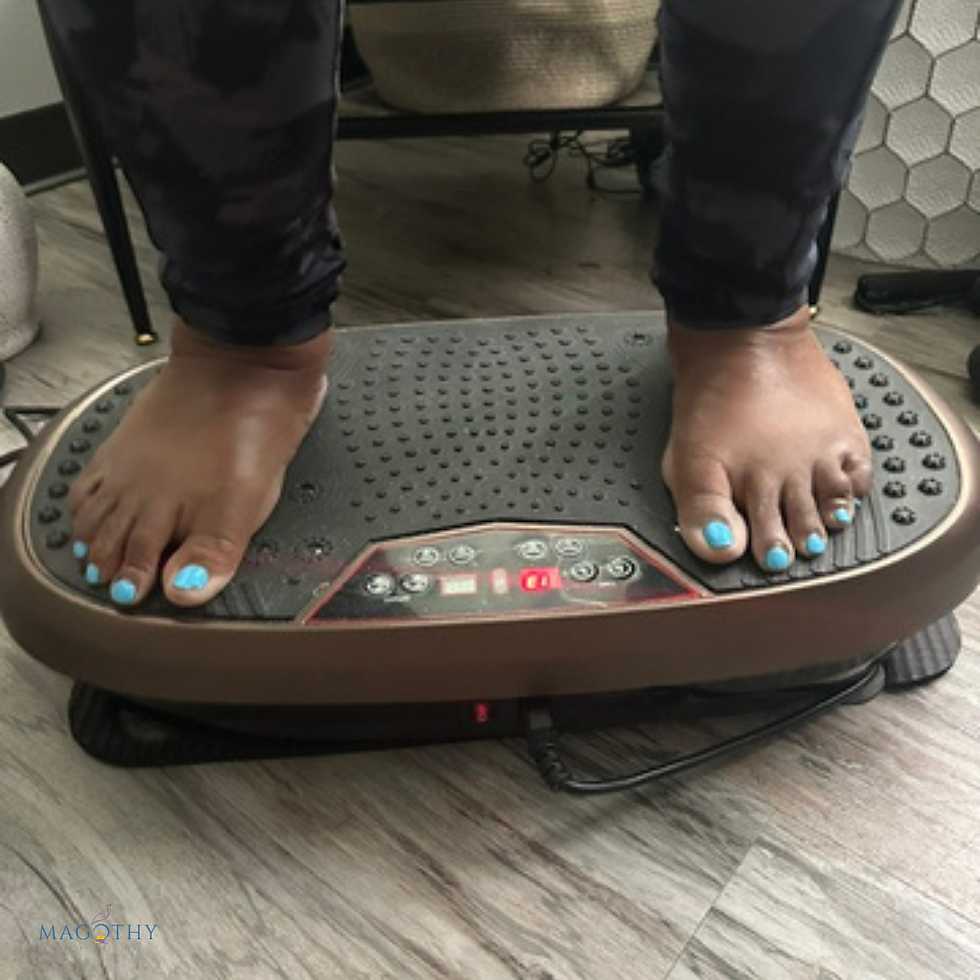
This is one of the BIGGEST things people don’t realize. There are different types of vibration technology.
Oscillating vibration
Oscillating or pivotal vibration generally moves the platform in an alternating, seesaw-like motion.
Think:
left → right → left → right
This creates a different mechanical stimulus than a platform moving uniformly up and down.
Vertical vibration
Vertical vibration moves more uniformly up and down.
Think:
up → down → up → down
This can create a different sensation and loading pattern.
Tri-planar/multi-directional vibration
Some platforms incorporate more complex movement patterns, potentially producing motion in multiple directions.
Why does this matter?
Because: different machines + different settings + different body positions = different experiences.
That’s why copying someone’s exact vibration-plate routine from Instagram or YouTube isn’t necessarily the best approach.
Their machine isn’t necessarily your machine. Their feet aren’t your feet. Their nervous system isn’t your nervous system. And their lipedema presentation isn’t yours.
Your feet are doing more than standing there!
Here’s another BIG vibration-plate secret:
Where you put your feet matters.
On many platforms, moving your feet closer together versus farther apart can change the experience.

Your stance can influence:
How much vibration you perceive
How your knees and hips respond
Which muscles are recruited
Your balance demands
Your comfort level
And your knee position matters, too. A soft bend through the knees can feel very different from standing rigidly upright.
That’s why I often encourage people to think: “How does my body respond here?”
rather than: “What number should I be using?”
Vibration plates aren’t just for standing!
This is where things get FUN. You can use a vibration plate as a platform for different movement patterns.
For example:
Wall Push-Up + Feet on the Plate:
Place your feet on the vibration plate while performing a controlled wall push-up.Now you’ve combined: upper-body movement + core engagement + lower-body vibration.
And because you’re using the wall for support, you can modify the challenge.
Supported Sit-to-Stand
Place your feet on the plate and use a chair for support. Practice controlled sit-to-stands while maintaining good alignment.
Heel-to-Toe Weight Shifts
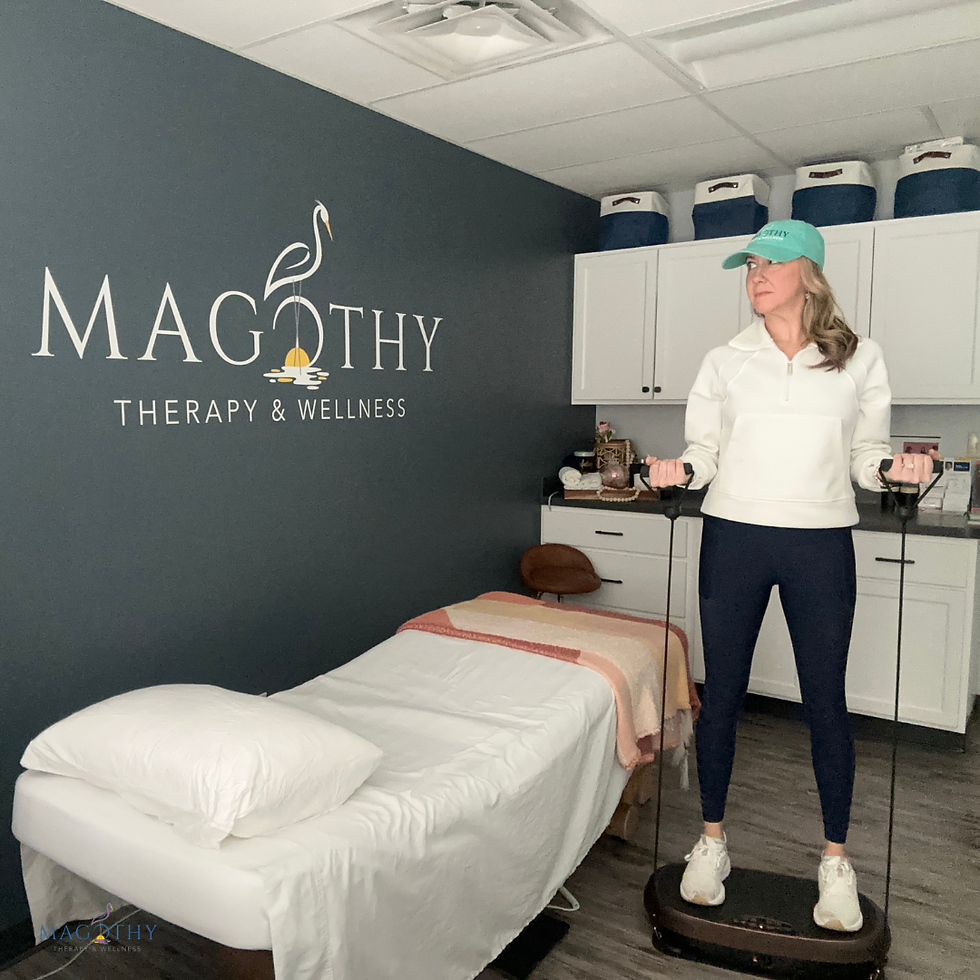
With appropriate support nearby, gently shift your weight from heels toward the balls of your feet. This can turn the plate into a proprioceptive playground.
Supported Calf Raise
Hold onto a stable surface and slowly rise onto your toes. The vibration adds another sensory and muscular challenge.
Mini Squat + Reach
With your feet positioned comfortably on the plate, perform a shallow squat while reaching forward or overhead. The goal isn’t depth. It’s controlled movement.
Here’s the most important part: Your vibration plate should be individualized.
There’s no magical: “10 minutes on level 8.”
That’s because your appropriate dose depends on things like:
Your goals
Your experience
Your balance
Your strength
Your sensory tolerance
Your symptoms
Your type of vibration plate
Your foot position
Your exercise selection
Your response during and after the session
At Magothy Therapy & Wellness, we can help you find the right type of vibration plate and sequence to align with your goals. Whether you're managing lipedema, recovering from surgery, or looking for general wellness help, we've got your back!
Ready to learn more? Check out our New Consult Bundle if you're looking to get started for the first time, or explore our other services. We would love to see you in clinic!


Comments